Showing posts with label amateur gardening. Show all posts

Tuesday, April 15, 2014

Garden Bloggers' Bloom Day - April 2014

So I've been lurking in the world of garden blogging, quietly posting, but more often, reading all the gardening blogs I can get my eyes on. I think it was probably Pam Penick's terrific blog, Digging, that clued me into the delightful monthly recurrence that is Garden Blogger's Bloom Day. On the 15th of every month, Carol at May Dreams Gardens hosts GBBD, in which she posts photos of what's blooming in her yard, and encourages other gardeners to do the same, and posts links to their blogs.

Being a novice gardener and blogger, I haven't yet had the audacity to post for Bloom Day... until today. Without further ado, onto the blooms!

As is the case in other parts of the US this year, the blooms here in Austin are a little behind. Maybe a month behind, if I reckon accurately.


The annual Gazania that I picked up recently sports a number of different colored blooms. At the moment, the only one opening during the day is this fetching maroon and white striped one, which my Aggie friends would love. I like that the maroon seems to be painted down the middle of the petal.


Purple Oxalis has been sending up dainty pale pink blossoms lately. These also seem to open just for the sun, then close for the day. They're in part shade here.


More annuals--Torenia 'Kauai Deep Blue' is strutting its stuff.
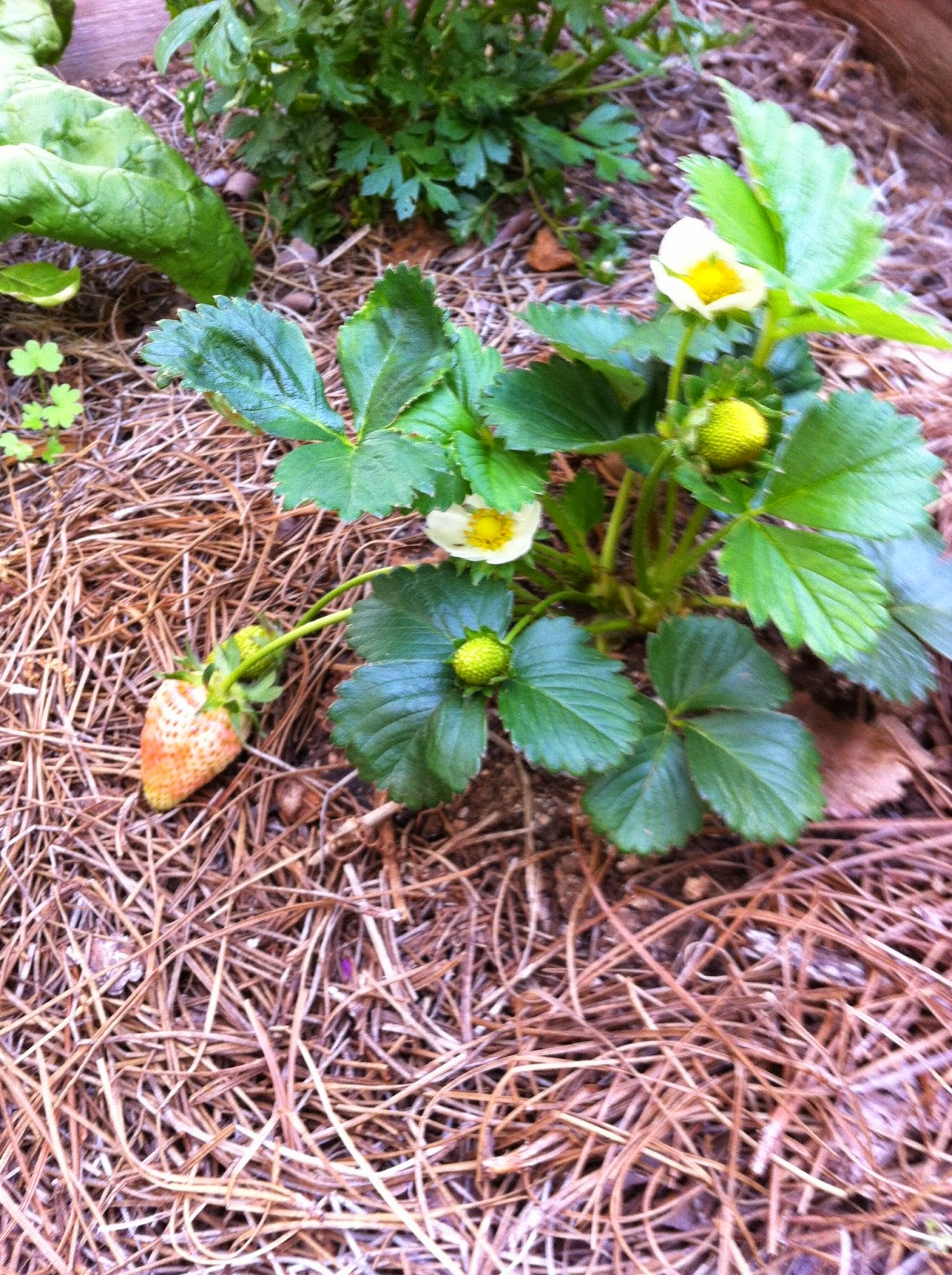

The strawberries the girls and I planted back in... November? They're regularly putting out charming white flowers, and even berries now. Can't wait to eat one--if we can get to them before the critters do!


Blurry close-up of a multiplying onion flower. My 3-year-old daughter loves these, but she can't muster the patience to avoid picking apart the flower wrapper to expose the circular head of flowers. At least this year she managed to do it gently. I see an Anole lizard photobombing this one, right above my older daughter's wall tag.


Crookneck Squash is putting out some bright yellow spring flowers.


Knockout Rose is back.


The first peak of the Yellow Shrimp Plant bloom showed up this week. This is a new plant in my garden, so I'm eagerly awaiting the show.


Salvia 'Mystic Spires' is putting up a pretty purple spire.

Martha Gonzales roses and Blackfoot Daisies are blooming in the front yard, along with Lavender and Salvia 'Caradonna Meadow Sage'. Here are a few pics:

Here's one of the two Martha Gonzales Roses in the parking strip, with its first blooms of the year. I managed to trim the other one, but didn't get around to this one (oops!) I might give it a light shaping this weekend.

A closer look at the merry Martha roses.

The Blackfoot Daisy I divided last fall--this is the mother plant. It's about half the size it was at the end of last summer.  This plant seems to love the hot, dry parking strip most of all. The babies are small, with just a few blooms right now. All in good time...

Here are some photos of the front-yard purple duo, Lavendar (I don't recall which species) and Caradonna Meadow Sage.

Here are the "twins", side by side in the front pea gravel bed.

Caradonna Meadow Sage doesn't bloom for very long in my garden, but those purple spikes are pretty, and the foliage makes an attractive mound for the rest of the year. This one is growing slowly, perhaps in part because I transplanted it from the parking strip last year.

Lavender -- this is my third attempt at growing this drought-tolerant beauty. I don't know why it took me so long to try it in the front yard, where it is decidedly sunnier, hotter and drier. I think the third time will be the charm, as this one already seems much happier than the previous two.


What has already bloomed and faded this year? Leucojum (Snowflakes) and my Texas Redbud tree.

What hasn't bloomed yet? Texas Mountain Laurel--and since it normally blooms here in February, we might have missed the opportunity this year. I saw one blooming at Springwoods Park here this past week, so I'm holding out hope.

Lantana, Pavonia (Rock Rose), Esperanza, Salvia Greggii 'Autumn Sage', and the crinum bulbs I planted haven't joined the party yet, but I wouldn't expect them to until the weather gets genuinely hot. Turk's Cap and Plumbago are still gradually recovering from the freezes, too.

Happy Bloom Day!

Saturday, March 16, 2013

March front yard update: If you can't get it to grow, try killing it.


 Finally... Spring has arrived. It easy to love our mild Austin winters, but the scenery gets a bit dull after three months. Most of our native plants are resting, and while evergreens can be lovely, and naked branches can be sculptural and mysterious, the return of the deciduous trees and perennials is always welcome.

Two years ago on my birthday, March 9, Rob bought and planted a Texas Redbud (Cercis canadensis var. Texensis) outside our kitchen window. When we first moved in, there was a thriving Hackberry in that spot. Though Hackberry is considered an invasive trash tree, I had enjoyed having some shade and attractive foliage to see from the kitchen table.

It had just a few blossoms the first year, followed by a thin covering of heart-shaped green leaves. I kept it irrigated through the scorching summer drought (2011) with a Tree Gator.

Every year, redbuds all over town burst into bloom three weeks before this one does, so every year I fear the worst. Last year, the blooming was so late and so minimal that a lanscape contractor that was bidding on some projects asked me if I wanted him to remove this dead tree.

About a week later, it bloomed, very sparsely.

This year I pruned it for the first time, about a month ago, and sprinkled the ground in the freshly cleaned-up bed around it with Rabbit Hill Farm Buds-and-Blooms fertilizer. I don't know whether it was the pruning, the fertilizer, or something else I did or didn't do, but this tree is exploding with beautiful blooms this year.

Cenizo, February 2013
Cenizo, March 2013
 I gave its bed neighbors a deep pruning, including a Cenizo (Leucophyllum frutescens) that had grown to an unruly size and shape for my tastes. Here it is, chopped to the ground. I don't see any new growth on the thickest trunks, but the water shoots are growing and may become the new Cenizo.

Pruning so drastically is a big leap of faith. I do remember that Rob and I tried to kill a shrub by cutting it to the ground one year, and it reemerged stronger, thicker and taller. I have read about the benefits of pruning. Still, it was emotional. I worried that I was going to kill the Cenizo, Esperanza, Pavonia and Lantana that share the SE wall bed with my birthday Redbud.

So far, it appears my faith will be rewarded. There is new growth on all of these plants. I imagine it will be even more vigorous as the temperatures rise and the days grow longer.


Here's a before-and-after of the Esperanza, a.k.a. Yellow Bells (Tecoma stans).


Here's the Lantana (Lantana involucrata) in front of two Rock Rose/Pavonia (Pavonia lasiopetala) that I planted at the same time, last fall. Just a week ago, there were few signs of life on the Lantana. Now there is a promising cluster of leaves and stems.


Behind the Pavonias sits a Plumbago (Plumbago auriculata) that I had to cut back drastically to keep it from choking out these other, new plants. It is still tall along the white brick wall, and from my kitchen window, I can see its lovely sky blue flowers along with the magenta blooms of the Redbud.


 In front of the SW-facing kitchen window, the ginger I planted in the fall did suffer a little bit of frost damage. But it is sending up new shoots and rebounding heartily, along with Turk's Cap (Malvaviscus arboreus var. Drummondii), Variegated Flax Lily (Dianella tasmanica Variegata) and Liriope (Liriope muscari 'Big Blue' and 'Aztec Grass').

The one remaining Pigeonberry (Rivina humilis) is beginning to leaf out and green up for Spring. This particular one has thrived since I planted it, but the two I planted next to it (in spots now occupied by Liriope) never thrived, and died off after the first frost.

Our Texas Mountain Laurel, sadly, did not bloom this year. I think we're past the bloom window now. It still has black seedpods attached to it, and I wonder if I should have removed those to stimulate new blooms.

I do see a little bit of new foliage growth on it, which, I hope, won't get devoured by caterpillars this year. I have Bt (Bacillus thuringensis) ready to go, just in case.

Elsewhere in the front yard, things are beginning to bounce back. I gave my one-year-old Martha Gonzales roses a conservative pruning in February. One of them was already starting to bloom, and kept right on blooming after pruning.


The other has stubbornly refused to bloom, and I started to worry that it wasn't getting enough water, as drought conditions continue this Spring.

One good rain and a liberal soaking with the hose later, it has one or two blooms on it.


The bare-root Methley plum tree I planted in the rock bed back in February (or was it late January?) is finally greening up, to my daughters' delight, and mine. Natalie keeps talking about the plums it will make. It'll be a good lesson in patience, I bet.
 I transplanted some of the plants from the parking strip to the rock bed back in February, too. So far, everything is surviving, and gingerly putting out some new growth.

This Autumn Sage (Salvia greggii) doesn't seem to have lost a single bloom, in spite of windy days and wild temperature fluctuations.
 This Caradonna Meadow Sage (Salvia nemorosa 'Caradonna') isn't showing any noticeable change since I transplanted it. It wasn't thriving where it was; I hope it will enjoy its new home more and give us some stunning purple blooms this year.
 I planted a couple of Mexican Feathergrass a couple of weeks ago. I can't help myself. I set out to have a very planned landscape, and I end up collecting plants.
 This Rosemary (Rosmarinus officinalis) is on its second transplant. The roots were so infested with Bermudagrass roots and runners that I picked them clean--no dirt at all. I figured this was a gamble, but the Rosemary didn't even flinch. It is settling into its new home nicely.

I have plans for the area at the NW side of the house, in front of the HVAC/recycle/trash cart area. I'm not exactly sure what will go in it yet, but there will be a bed bordered in limestone blocks, generously donated by my mom, who lives in Dripping Springs.

Rachel already tested out their climb-worthiness.

This morning I was inspired at the Lady Bird Johnson Wildflower Center, by this lovely groundcover with pink-red berries, Coral Berry (symphorocarpos orbiculatus), that seemed to like its shady spot. I might have to include it as a border in this limestone bed, or in the backyard around the Cedar Elm.


Sunday, January 20, 2013

Hi! This is my first post in my brand new garden blog. I started it at the end of September, and I'm just now getting around to posting it.

I hope you'll forgive me for rambling and being disorganized here in the beginning. I've been reading some impressive garden blogs that are stunningly photographed and organized. I am not there yet.

Pictured at right is the new fall garden box my husband built for me at the end of August. I direct-seeded way too many things, and threw in a couple of cucumber transplants just for instant gratification.

I am very much an amateur gardener. I have never had a real garden box before. A few years' experiments with a few tomatoes, peppers and herbs in pots never yielded much success. The few successes I could not take credit for--volunteer Juliette cherry tomatoes that went wild with fruit for the past two years, and serrano peppers that didn't give up even after I did. Once I noticed that they were thriving, I started watering again.


I've diligently watered our St. Augustine lawn since we moved into this house 6-1/2 years ago, and gradually come to the conclusion that I don't like caring for such a boring and thirsty plant. In the meantime, we planted a row of 9 (!) crape myrtles of varying sizes along the back fence, to serve as a privacy screen. This has been a mixed success at best, for several reasons. Crape myrtles are deciduous, so that screen is only up for about 8-9 months a year. We didn't know anything about the varieties we bought--just that they were on sale at Red Barn Garden Center and we liked the colors and wanted a few different heights.


I enjoyed what little gardening I did, while it was also frustrating and I felt like I never knew enough to really get into it. I was intimidated by the vast amounts of information out there, and my success rate at winging it was pretty lousy. I probably killed 3 out of every 4 plants I cared for, before they could produce flowers or fruit, or get to the proper height, or other measure of success.

 My husband, Rob, built a beautiful covered deck in the backyard, finishing right before our first daughter was born. We were working hard to great a lovely and functional home, and loved the deck right away, but still lamented that our yard wasn't what we wanted it to be.

I knew I wanted a beautiful yard, and didn't know how to get there.

I had a demanding job, which I traded for life as a busy stay-at-home-mom when my first daughter was born. It wasn't until my second daughter was about a year old (and my oldest was 2-1/2) that I caught Garden Fever.

I started watching Central Texas Gardener, which stoked my interest and faith in gardening here in challenging Austin. I saw an interview on CTG with David Meeker of Porthole Design, and contacted him to come help us craft our vision for our yard. I knew I wanted something relatively low-maintenance and drought-tolerant, with added privacy around the fence line.

 This week, one month after starting that fall garden, we had Porthole Design carve out, level and install pea gravel pathways around the house.

They excavated a huge amount of dirt and sod, which we were able to donate to our girls' school, the Joyful Garden, for an upcoming hugelkultur project. I love it when things work out like that!

 After day one, there was nothing but bare dirt.
 At the end of the following day, the guys had installed landscape edging, brought in 3-mix and road base and tamped/leveled it, and topped it with almost an inch of pea gravel.

We have walkways. Some of them are plantable--I'll probably hold off until spring for that, though it is so tempting to start now.


 David Meeker assures me that the relatively loose pea gravel will tamp and pack down with time. We had a big fall rain just following installation, and I was pleased to see that we barely had to rake or sweep any rocks back into place.

We particularly love this backyard area, which for now we are using as a gathering area around our previously neglected fire pit.


Here's a little Butterfly Garden nook along the back fenceline. I'd like to expand it in the coming years. We've seen Monarchs lingering on the Tropical Butterflyweed, and Swallowtails on the Bougainvilleas.


Top-of-electrical-box experiments. This can't be the safest place to have these little guys.


The Japanese Yew I planted in the front yard kitchen window bed isn't going to make it, sadly. I think I either overwatered when it was in the ground, or left it in the container too long and underwatered it then. Oh well! The Turk's Cap is taking off like gangbusters. In my mind, it was supposed to be the shorter plant in between the tall Yew and Mountain Laurel (such a slow grower... maybe in 15 years?)

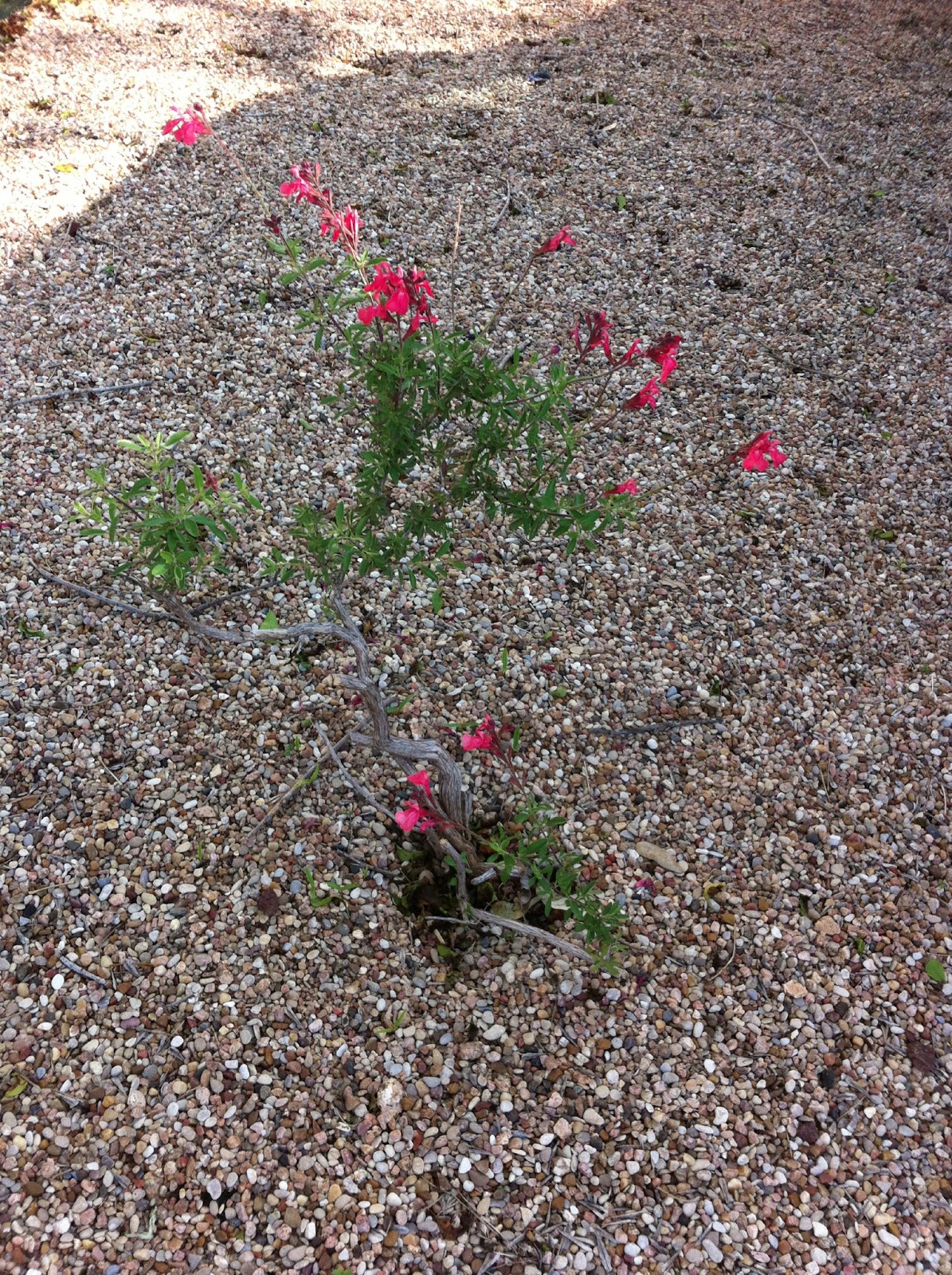
Recently, I fell in love with Caradonna Meadow Sage and bought one, along with a charming Blackfoot Daisy. I planted both in the front yard death strip, but I'm not sure it's their permanent home. It's so much trouble to weed, and I can't seem to get the upper hand on the bermudagrass there. Someday I'll dig it all out, transplant the perennials, and backfill it with decomposed granite and yuccas and succulents. I want to get to where I neither have to weed nor water this area more than a handful of times a year.


We bought a lovely loquat bush/tree at the Natural Gardener in January of 2012, and it has been reliably attractive and low-maintenance. In 100+ degree weather, I watered it weekly, slow-dripping the hose for an hour. In hot but not scorching weather, I backed off to every two weeks. It gets some water when I water the cursed St. Augustine. It seems happy with this routine.


Cenizo, esperanza (yellow bells), plumbago, a Texas Redbud and wild garlic chives fill the informal bed on the SE side of the house. Note the TreeGator on the redbud. This is probably what saved it in 2011. I planted it March 9, 2011, as the worst draught year in history was just kicking off. It survived, but barely bloomed at all in 2012. I'll be watching carefully as bloomtime 2013 approaches.


Here's Natalie at Barton Springs Nursery, along with me as I picked out some ginger, flax lily and liriope to replace the dead Japanese Yew in the kitchen window bed.

I attempted to grow vegetable seedlings in the garage. After about three weeks, they looked like this. They didn't last more than a few days in the garden--I think maybe squirrels ate them. Maybe transplants should be a lot bigger. For now, I'm going to give up direct-sowing and buy transplants.